Why Replacing Broken Chargers Shouldn't Be a Capital Project
There are EV chargers sitting in commercial parking lots right now that haven't worked in months. In some cases, they've been offline even longer.
Property managers know they're broken. Tenants know they're broken. Drivers who have tried to use them certainly know they're broken. Yet the equipment remains in place because replacing it can sound like the beginning of another major capital project.
That assumption is understandable. If the original EV charging installation involved electrical work, permitting, construction, equipment procurement, network setup, and multiple vendors, it is easy to assume that replacing a failed charger means starting that entire process again.
But that isn't always the case.
When EV charging infrastructure already exists at a property, the better first question is, "What do we already have that can still be used?"
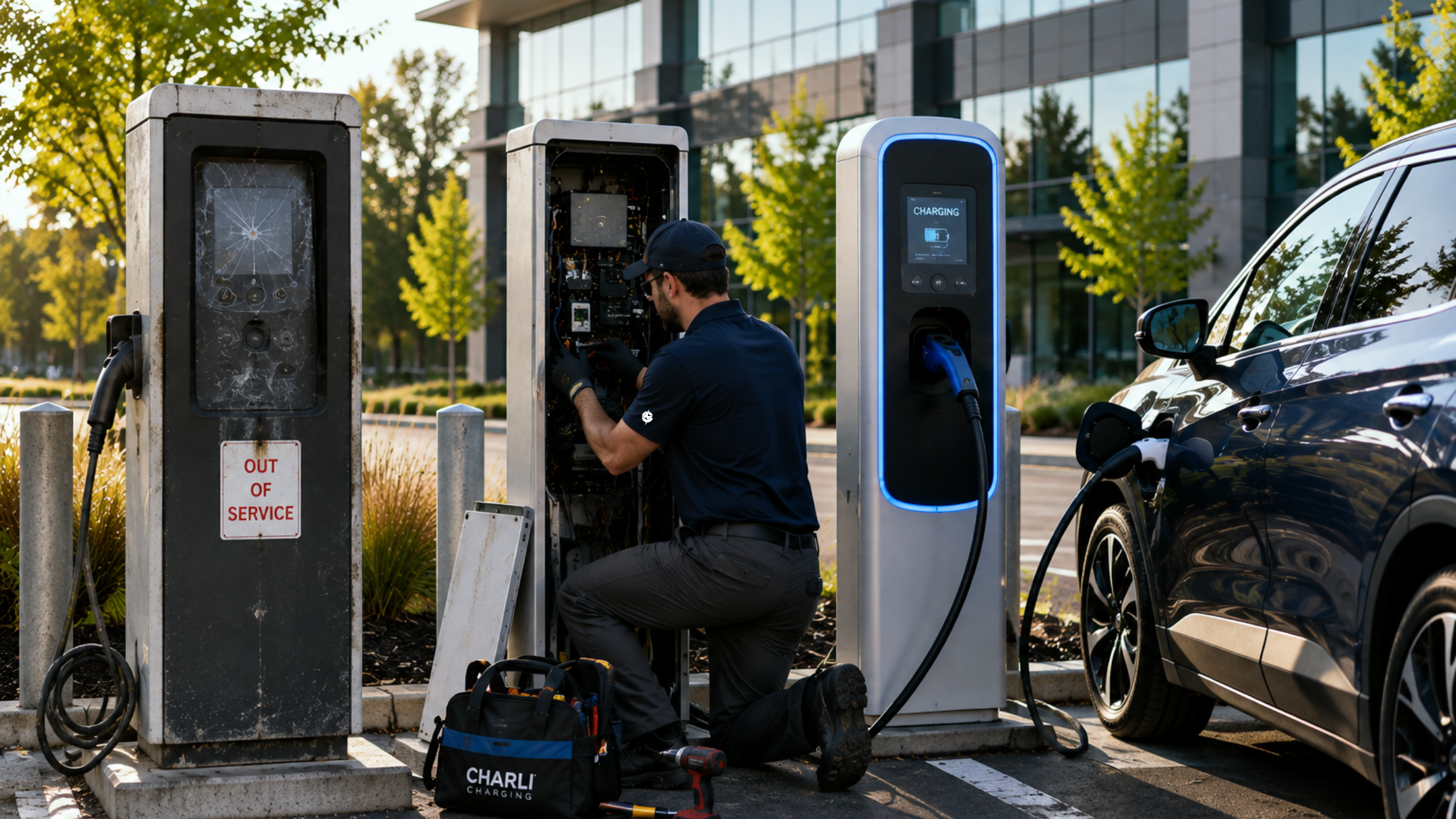
A Broken Charger Doesn't Mean the Entire Installation Has Failed
One of the most important distinctions property owners can make is between failed charging equipment and failed infrastructure.
A charger can stop working for several reasons. The hardware may be outdated or no longer supported by the manufacturer. Replacement parts may be difficult to obtain. The network or software supporting the charger may no longer meet the property's needs. In other cases, the equipment may simply have reached the end of its useful life.
None of those situations automatically means everything behind the charger needs to be replaced.
The property may already have electrical service, conduit, wiring, dedicated parking spaces, signage, or other infrastructure that can potentially support new equipment. If those assets remain usable, replacing the charger may be a much smaller project than installing EV charging at a site for the first time.
That is why an assessment of the existing installation should come before assumptions about cost or complexity.
Start With What Is Already There
Before developing a replacement plan, property owners should understand what they already have.
That means looking beyond the charger itself and evaluating the electrical infrastructure supporting it. What condition is the existing equipment in? Is there adequate electrical capacity? Can existing conduit or wiring be reused? Does the current location still make sense? What caused the original charger to become unreliable?
Those answers help define the actual scope of the project.
Sometimes replacement may be relatively straightforward. Other properties may require upgrades or changes before new equipment can be installed. Either way, the property owner gets a much clearer picture than they would by assuming a broken charger means another large construction project.
This approach also helps avoid unnecessary spending. There is little value in replacing infrastructure that still works simply because the equipment connected to it does not.
The Cost of Doing Nothing Is Easy to Miss
Leaving a broken charger in place can feel like the least expensive option because there is no immediate project expense. But that does not mean the property isn't paying a price.
EV charging is increasingly offered as an amenity at workplaces, multifamily communities, retail properties, hotels, and other commercial locations. When that amenity is consistently unavailable, tenants and visitors experience the failure directly.
A driver does not necessarily know whether the problem involves hardware, software, networking, or an electrical component. They know they arrived expecting to charge and couldn't. Over time, that affects whether people trust the charging infrastructure at the property at all.
For property managers, that creates an interesting contradiction. The chargers may technically still be part of the property's amenity package, but if drivers cannot rely on them, they are providing very little value. In some cases, visibly broken equipment may create a worse impression than not offering charging at all.
Delaying replacement therefore has its own cost, even when that cost doesn't appear as a line item in the capital budget.
Replacement Is Also an Opportunity to Fix the Original Problem
There is another reason property owners should resist simply swapping one charger for another. If the original charging setup struggled, it is worth understanding why. The issue may have been the equipment itself, but it could also have involved maintenance, networking, driver support, utilization, or the way the charging solution was originally designed for the property.
Installing new hardware without answering those questions can recreate the same problem with newer equipment.
A replacement project provides an opportunity to reconsider how EV charging should function at the property today. That includes thinking about who uses the chargers, how frequently they are used, what level of charging is appropriate, how the equipment will be monitored, and what happens when something goes wrong.
The objective shouldn't simply be to have working chargers on the day they are installed. Property owners need infrastructure they can reasonably expect to remain useful and manageable over time.
Property Managers Shouldn't Have to Become EV Experts
Part of the hesitation around charger replacement is workload.
Commercial property managers already coordinate building systems, maintenance, vendors, tenants, budgets, capital improvements, and unexpected problems. A failed EV charger can quickly become another specialized issue requiring calls to manufacturers, electricians, network providers, and service companies.
That complexity can make postponing the problem tempting.
A better approach is to treat charger replacement as an infrastructure problem that needs a clearly defined path forward. Assess what exists, determine what can be reused, identify what needs to change, evaluate the appropriate replacement solution, and understand who will be responsible for keeping the new equipment operational.
Property managers don't need to become charging experts to accomplish that. They need a partner who can help make the process easier to manage.
Funding May Make the Project Even More Manageable
Cost still matters, especially when charger replacement was not part of the property's planned capital spending. But before assuming the property must absorb the full cost of an upgrade or replacement, owners should also understand what funding opportunities may be available.
EV charging grants, utility programs, rebates, and other incentives can potentially change the economics of a project. Eligibility varies by location, property type, equipment, program requirements, and other factors, which is another reason planning before an application deadline matters.
For a property with existing chargers, understanding the condition of the current infrastructure creates a stronger starting point. Once the actual project scope is known, owners can more effectively evaluate whether an available funding opportunity aligns with what the property needs.
With new EV infrastructure funding opportunities emerging in markets including Oregon and California, now is a good time for property owners with aging or nonfunctional chargers to take another look at equipment they may have written off.
Before You Assume You Need to Start Over
A broken charger needs attention, but it doesn't automatically require rebuilding an entire EV charging installation.
The first step is understanding what failed, what still works, and what infrastructure can be preserved. From there, property owners can make informed decisions about replacement equipment, necessary upgrades, project costs, and potential funding.
That may reveal a much more manageable project than expected.
And if the property does require a larger investment, the decision will at least be based on the actual condition of the site rather than an assumption that replacing a charger means starting from scratch.
Have Chargers That Aren't Working?
If your property has outdated, unreliable, or nonfunctional EV chargers, Charli Charging can help you determine what it will take to get your infrastructure working again.
Our team can evaluate your existing setup, identify potential replacement or upgrade options, and explore current funding opportunities that may help support your project.