How Battery Storage Can Offset EV Infrastructure Costs
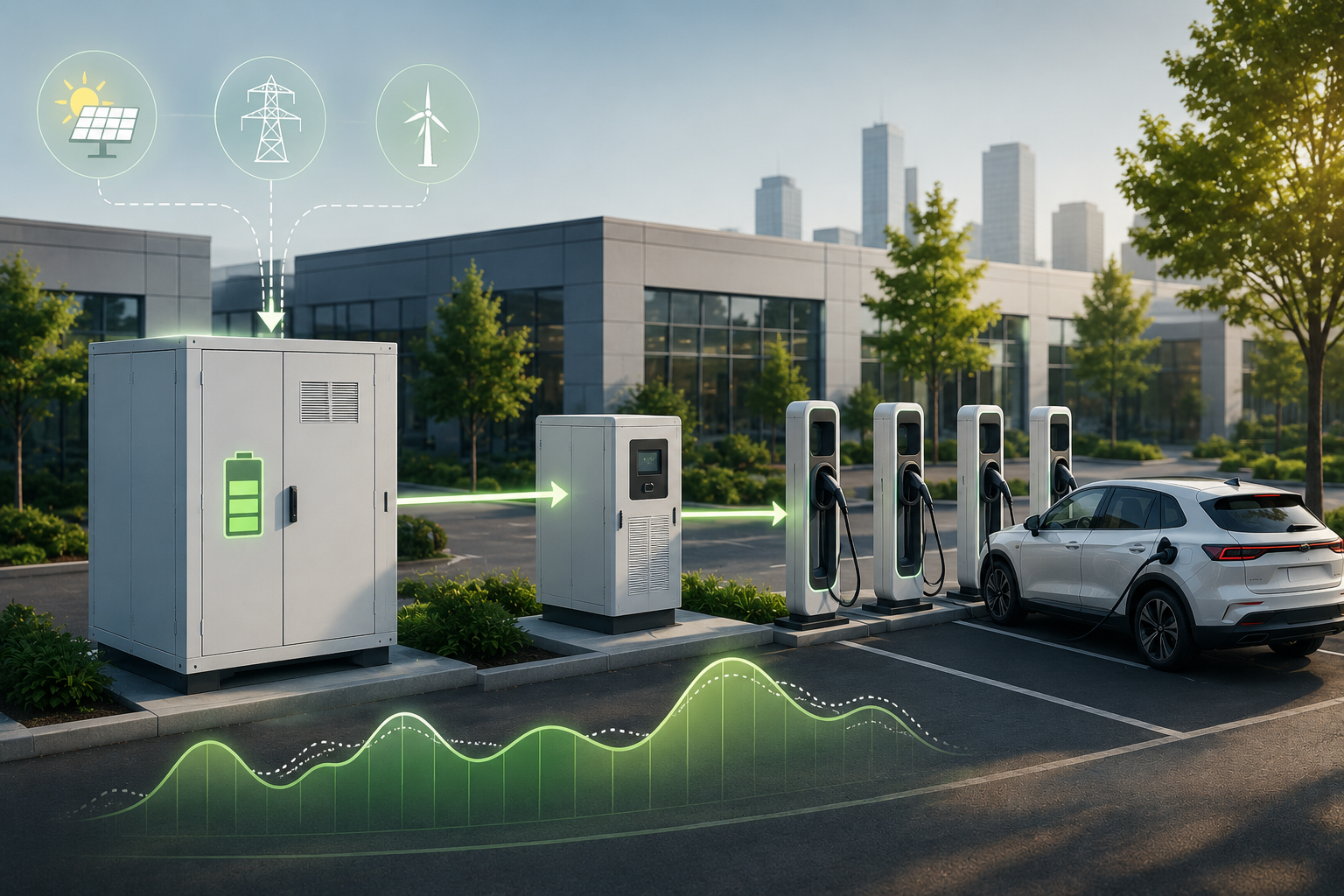
Why some commercial properties are pairing batteries with EV charging deployments.
One of the biggest misconceptions around EV infrastructure is that the charger itself is the most expensive part of the project.
In many cases, it is not.
For commercial properties, the larger challenge is often the surrounding electrical infrastructure required to support high-powered charging at scale. Utility upgrades, demand charges, site limitations, and long-term operating costs can all impact the economics of deployment.
That is one reason more property owners are starting to evaluate battery storage and EV charging together instead of separately.
The Infrastructure Conversation Is Changing
As EV adoption continues to grow, commercial properties are under increasing pressure to modernize. Retail centers, multifamily developments, workplace campuses, and mixed-use properties are all beginning to evaluate how charging infrastructure fits into their long-term plans.
But many quickly run into the same issue: power demand.
Fast charging requires substantial energy capacity, especially in locations where multiple vehicles may charge simultaneously throughout the day. Depending on the property, upgrading grid capacity alone can become a major expense.
Battery storage changes that equation.
“Instead of relying entirely on direct grid power during peak demand periods, battery systems can help support charging loads using stored energy. That flexibility can reduce strain on the grid while helping properties better manage energy usage and operating costs over time.”
Why Properties Are Pairing Storage With Charging
Commercial operators are beginning to realize that charging infrastructure works best when it is treated as part of a broader energy strategy.
Battery-backed charging deployments can help properties:
reduce peak demand charges
improve energy resiliency
support future charging expansion
better manage utility costs
create more flexibility for constrained sites
For some properties, this approach may also reduce the scale of utility upgrades required upfront, helping improve overall project feasibility.
That is especially important as more operators look for practical ways to deploy EV infrastructure without taking on excessive capital risk.
The Shift Toward More Flexible Deployment Models
Historically, EV infrastructure projects were often approached as standalone installations with significant upfront costs tied to equipment and electrical upgrades.
That model is evolving.
More companies are exploring flexible deployment strategies that combine charging infrastructure with battery storage to create a more balanced long-term operating model. Instead of focusing only on charger installation, the conversation is shifting toward total energy management.
For commercial properties, that creates an opportunity to think beyond simply “adding chargers” and instead evaluate how energy infrastructure can support broader operational goals.
Why This Matters for Commercial Real Estate
Commercial real estate owners are increasingly competing on experience, convenience, modernization, and long-term operational efficiency.
Charging infrastructure is becoming part of that conversation.
For retail properties, charging can increase dwell time and customer convenience. For workplace environments, it can support employee expectations. For multifamily developments, it is increasingly viewed as a future-ready amenity.
Battery-backed systems add another layer of flexibility by helping properties better manage how that infrastructure performs financially over time.
The result is a conversation that is becoming less about whether EV charging is coming and more about how properties can deploy it strategically.
What This Means for Property Owners
The economics behind EV infrastructure are evolving quickly, especially for commercial properties looking beyond the traditional charging model.
Battery storage is helping shift the conversation from simple charger deployment to broader energy strategy, giving properties more flexibility in how they manage power, operating costs, and long-term infrastructure planning.
As adoption continues to grow, the properties that think strategically about charging and energy management together may be better positioned for the future than those approaching them separately.