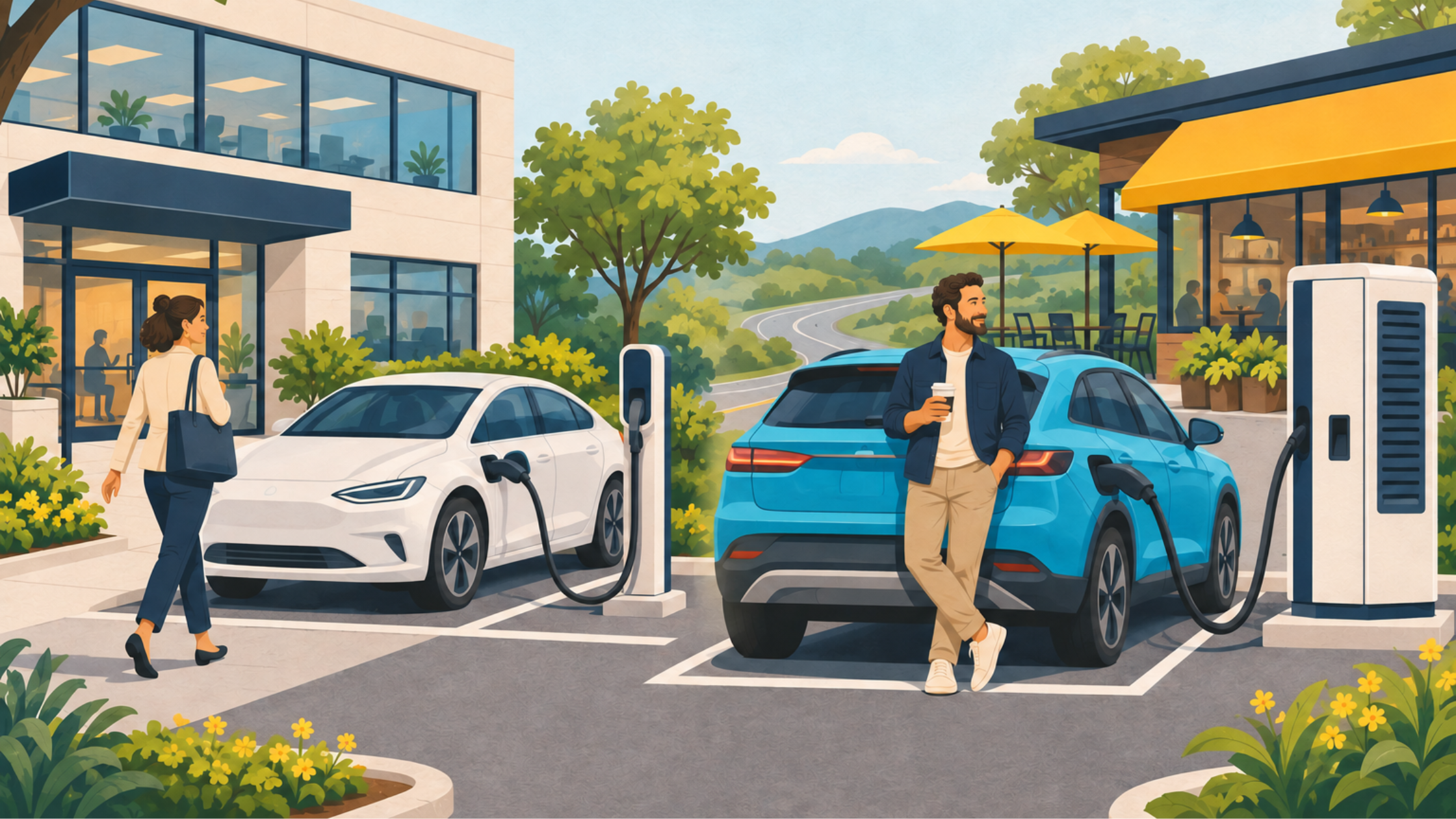
A property owner asks about EV charging, and one of the first questions is usually about speed.
“How fast can we charge a car?”
It’s a fair question. But before choosing equipment, there’s another one worth asking:
“How long are people already parked here?”
An employee arriving for a full shift has a different schedule than someone stopping for lunch during a road trip. A resident parking overnight has different needs than a fleet driver heading back out for another route.
Understanding those routines helps you decide what charging needs to accomplish at your property.
What’s the difference?
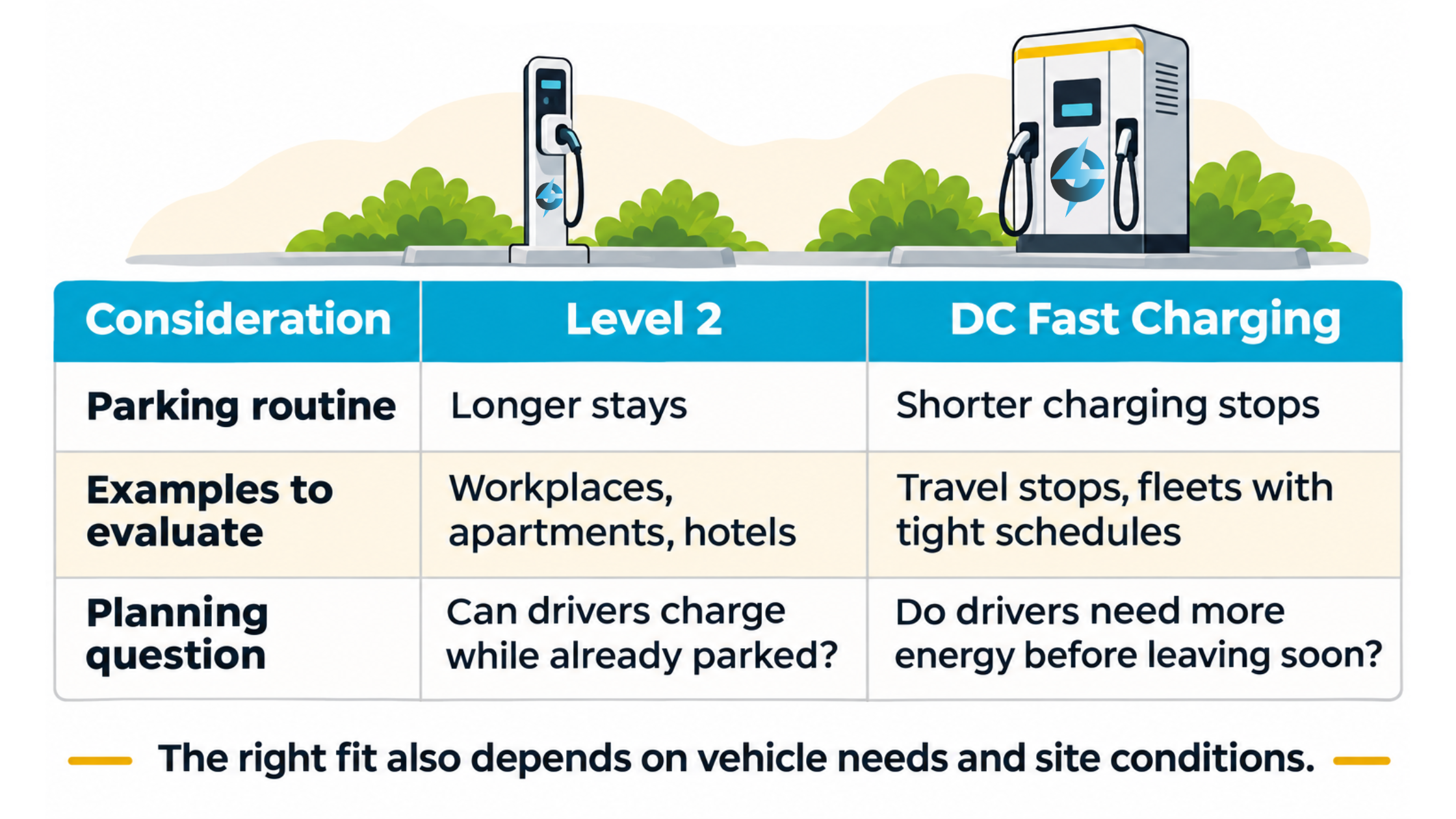
Level 2 charging supplies alternating current, or AC, which the vehicle converts to charge its battery. It’s commonly considered for places where vehicles stay parked for longer periods, such as workplaces, apartments, and hotels.
DC fast charging supplies direct current to a compatible vehicle’s battery and can deliver energy more quickly. It can be useful when drivers need to charge during a shorter stop.
Actual charging speed depends on the equipment, the vehicle, the battery’s condition and charge level, and other operating conditions. A charger’s advertised power doesn’t guarantee that every vehicle will charge at that rate.
For property owners, the practical question is whether the charging can meet drivers’ needs during the time they have available.
When vehicles stay for hours
Consider an office where employees arrive in the morning and leave late in the afternoon. Their cars may sit for most of the workday. Charging can happen while they’re working, without requiring a separate trip or a dedicated stop.
That makes Level 2 worth evaluating.
A similar conversation applies to residents parking overnight or hotel guests staying until morning. In each case, the vehicle may have a longer window to charge. Federal guidance identifies locations with longer parking periods as typical settings for Level 2 charging.
But parking time is only the starting point.
How much energy do those drivers need? How many vehicles would share the chargers? Can people leave their cars in the charging spaces, or would they need to move them?
An eight-hour shift doesn’t necessarily mean every employee gets eight hours connected to a charger.
When drivers need to leave soon
Now picture a driver stopping during a longer trip. They need enough charge to continue and expect to leave shortly. Or consider a fleet vehicle that returns between routes and has a limited window before its next departure.
Those situations may justify evaluating DC fast charging.
The next step is to understand the vehicles, the energy needed, and the available charging window. A short visit alone doesn’t establish that fast charging is the right investment.
For a retail property, for example, ask whether drivers are coming specifically to charge or simply plugging in while they shop. Are you trying to support a brief top-up, or serve drivers who need a substantial charge before leaving?
Those are different goals, even when the parking spaces look the same.
Your property may have more than one routine
Some sites serve employees, visitors, and fleet vehicles throughout the day. You don’t have to assume one charging approach will serve every group equally well. It may be worth evaluating a mix of equipment or introducing charging in phases. Start by identifying the main need. Then consider where other uses overlap.
For example:
Employees may park all day while visitors stay for an hour.
Residents may need charging overnight while daytime spaces serve guests.
Fleet vehicles may have different departure times and charging priorities.
The goal is to understand those patterns before deciding how many ports to install and what type of charging they should provide.
The site has a say, too
Once you understand the drivers, the property itself needs a closer look. Available electrical capacity, equipment placement, utility coordination, installation work, and ongoing electricity costs all influence the options.
DC fast charging generally involves higher power requirements and greater equipment and installation costs than Level 2. The specifics need to be evaluated for the proposed equipment and site.
That’s why a recommendation should connect the charging need with what the property can support. Ask your charging partner to explain the reasoning. What need does the proposed equipment address? What site work would it require? What alternatives were considered?
You should understand why the approach fits.
Bring these questions to the conversation
Before comparing chargers, gather what you know about daily use:
Who would charge here?
How long do they typically park?
How much driving do they need charging to support?
How many vehicles might need charging at the same time?
Can drivers move their vehicles once charging is complete?
Which needs are immediate, and which are part of a future plan?
You don’t need perfect data to get started. Tenant requests, employee feedback, parking observations, and fleet schedules can all help make the conversation more specific.
At Charli Charging, we help property owners work through those decisions, with installation, maintenance, and 24/7 customer support as part of our service.
If you’re considering Level 2, DC fast charging, or a combination of both, tell us how people use your property. We’ll help you explore an approach that fits.