The Massive Corporate Demand for EV Charging and What It Means for Your Property
Something has shifted in the way corporate tenants think about the buildings they occupy. It used to be that EV charging was a nice-to-have, a forward-thinking perk that progressive companies offered to attract eco-conscious employees.
That's no longer where we are.
Today, EV charging is moving from amenity to requirement, driven by ESG reporting mandates, corporate fleet electrification commitments, and a workforce that increasingly expects it. For commercial property owners, the question is no longer whether tenants will demand EV charging. It's whether your property will be ready when they do.
The ESG Pressure Is Real and It Runs Straight Through Your Building
Corporate sustainability reporting has gone from a PR exercise to a business requirement. Public companies face growing pressure from investors, regulators, and customers to disclose and reduce their emissions, including Scope 3, which covers indirect emissions from sources like employee commuting.
That matters to property owners because when a corporate tenant is trying to reduce their Scope 3 footprint, one of the most visible and measurable things they can do is support EV adoption among employees. And they can only do that if your building has charging infrastructure.
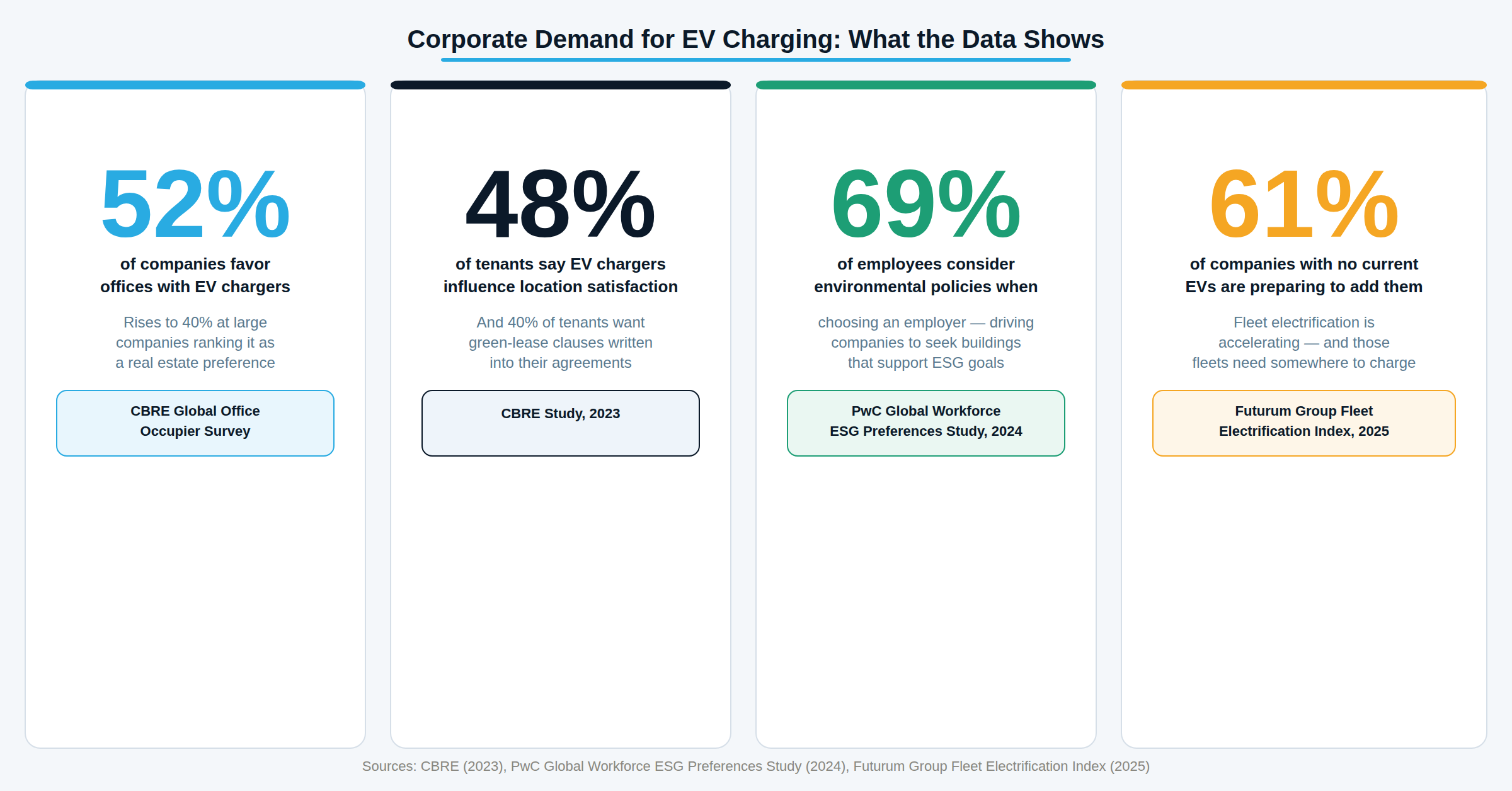
The data backs this up. According to a 2023 CBRE study, 48% of tenants say EV charging stations influence their location satisfaction and 40% of tenants want green-lease clauses written into their agreements. A green lease is no longer fringe. It's becoming standard language in commercial real estate negotiations, and EV charging is frequently part of what tenants are asking for.
Meanwhile, PwC's 2024 Global Workforce ESG Preferences Study found that nearly 69% of employees consider a company's environmental policies an important factor when choosing an employer. Companies chasing talent are feeling this and they're looking to their real estate to help them deliver.
“When a corporate tenant can’t check the box on EV charging at your property, it’s not just an inconvenience, it’s a gap in their sustainability reporting. That’s a lease-renewal conversation you don’t want to have.”
Workplace Charging Is Surging and Demand Is Outpacing Supply
The numbers on workplace charging tell a clear story. According to CBRE, roughly 70% of prime U.S. office buildings are now equipped with EV charging ports. Active workplace charging ports on ChargePoint's network grew 22% year-over-year in 2023, while the number of unique drivers charging at workplaces grew 57% over the same period, meaning demand is growing far faster than new stations are being installed.
Put another way: there were an average of twelve EV drivers per active workplace charging port in 2023, compared to eight before the pandemic. Tenants are already feeling the crunch. Employees are competing for chargers. And companies are choosing buildings, at least in part, based on whether they can offer this.
CBRE's Global Office Occupier Survey found that 52% of companies favor offices with EV chargers. At large companies, the tenants that anchor Class A buildings and sign the longest leases, that number climbs to 40% ranking it as a preference factor in real estate selection. That's not a niche preference. That's a majority signal.
“EV charging at the workplace isn’t just about charging cars anymore. It’s become part of the return-to-office calculus — a tangible benefit that helps companies incentivize employees to come in.”
Corporate Fleets Are Going Electric and They Need Somewhere to Charge
The demand for workplace EV charging isn't only coming from employees driving personal vehicles. Corporate fleet electrification is accelerating rapidly and fleet EVs need depots, which means properties need charging.
According to The Futurum Group's 2025 Fleet Electrification Index, which surveyed 165 large U.S. enterprises with revenues over $100 million, 61% of companies with no current EVs in their fleet are actively preparing to integrate them. This isn't aspirational, it's operational planning in motion.
For commercial property owners with tenants in logistics, delivery, healthcare, retail distribution, or professional services, virtually any sector that relies on vehicles, fleet electrification translates directly into demand for on-site charging infrastructure. Tenants who electrify their fleets need to charge those vehicles where they're garaged or parked during the day. If your property can't support that, it becomes a practical obstacle to your tenant's operations.
Companies with electric fleets are also willing to pay for the infrastructure. ING Research found that logistics tenants with electric fleets will pay higher rents for properties with charging capabilities, for two reasons: lower fueling costs compared to public charging, and reduced operational risk from having control over their charging schedule.
What This Means at the Lease Table
The shift in corporate demand is already showing up in lease negotiations — and in property valuations. Consider:
Office buildings with workplace EV charging command 5–10% rent premiums over comparable properties without it, according to industry analysis.
Commercial properties with EV charging infrastructure see estimated property value increases of 3–7%.
Properties offering EV charging maintain higher occupancy rates and are increasingly categorized as Class A, while those without it are being quietly downgraded in tenant preference rankings.
Only about 5% of U.S. multifamily properties currently offer on-site EV charging, creating a significant gap between what residents want and what's available. For multifamily owners, this gap represents both a risk and an opportunity.
The trajectory is clear. EV charging is following the same path as reliable high-speed internet, first a differentiator, then a standard expectation, then a requirement. The properties that moved early on WiFi infrastructure held an advantage for years. The same dynamic is playing out with EV charging right now.
“This isn’t about being green. It’s about being competitive. The corporate tenants signing five- and ten-year leases today are the ones whose expectations will define what ‘Class A’ means tomorrow.”
What Property Owners Should Be Doing Right Now
The good news: you don't have to build a massive charging infrastructure overnight to get ahead of this. But there are concrete steps that position your property well:
Audit your electrical capacity. Understanding what your current infrastructure can support and what upgrades would cost, is the essential first step before any charger conversation.
Start with Level 2. For most office, retail, and multifamily properties, a bank of Level 2 chargers is the right starting point. It serves employee and resident demand at a manageable cost.
Design for scalability. Install conduit and electrical panels now that can accommodate more chargers as demand grows. The cost difference between doing it right the first time versus retrofitting later is significant.
Have the lease conversation proactively. Tenants who are thinking about EV charging during a renewal negotiation are already behind on their planning. Bringing it up first signals that you're a forward-thinking partner, not a landlord they need to push.
Explore rebates and incentives. Oregon and the Pacific Northwest have active utility incentive programs for EV charging installation. Portland General Electric's Level 2 rebate program, for example, can substantially offset upfront costs.
The Demand Is Here. Is Your Property?
Corporate tenants are making EV charging a condition — not a request. Employees are choosing workplaces based on it. Fleets are requiring it. And properties that have it are commanding better rents, longer leases, and higher valuations than those that don't.
The window to act ahead of this curve is open. But it won't stay that way.
If you'd like to talk through what EV charging infrastructure would look like for your property — including what incentives are available and what it actually costs to get started — reach out. We're happy to walk you through it.