Parked Cars or Power Plants? What V2G Technology Means for Your Commercial Property
There's a question commercial property owners rarely think to ask: what if the cars parked in your lot were generating revenue while they sat there?
It sounds like something out of a utility company brochure. But it's not. Vehicle-to-grid technology or V2G for short, is already moving out of the pilot phase and into real commercial applications. And the property owners who understand it now will have a significant edge over those who learn about it later.
Here's what you need to know.
What Is V2G, Exactly?
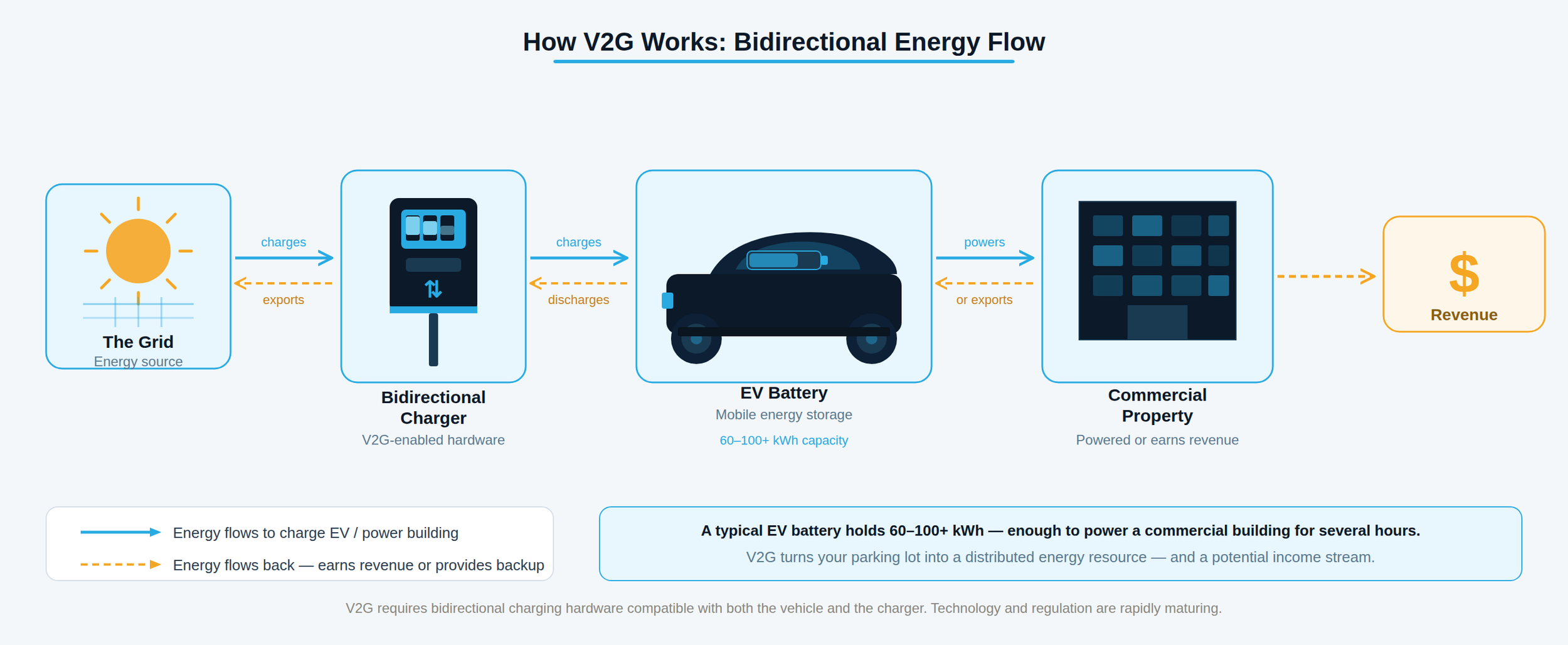
When an EV is plugged in, it's connected to the electrical grid. Traditionally, that's a one-way relationship: the grid charges the battery. V2G flips the equation.
With bidirectional charging equipment, an EV can do both — pull energy from the grid when demand is low, and push energy back to the grid when demand is high. The car becomes a temporary power source. A mobile battery, essentially, that can be tapped when the grid needs it most.
Think of it this way: a typical EV battery holds 60 to 100+ kilowatt-hours of energy. The average U.S. commercial building uses roughly that amount of energy in just a few hours of peak operation. A parking lot full of EVs, all plugged in and V2G-enabled, represents a significant distributed energy resource; one that sits on your property, costs you nothing to acquire, and can be monetized.
“V2G doesn’t just make your property EV-ready. It makes your property part of the energy infrastructure — a fundamentally different value proposition.”
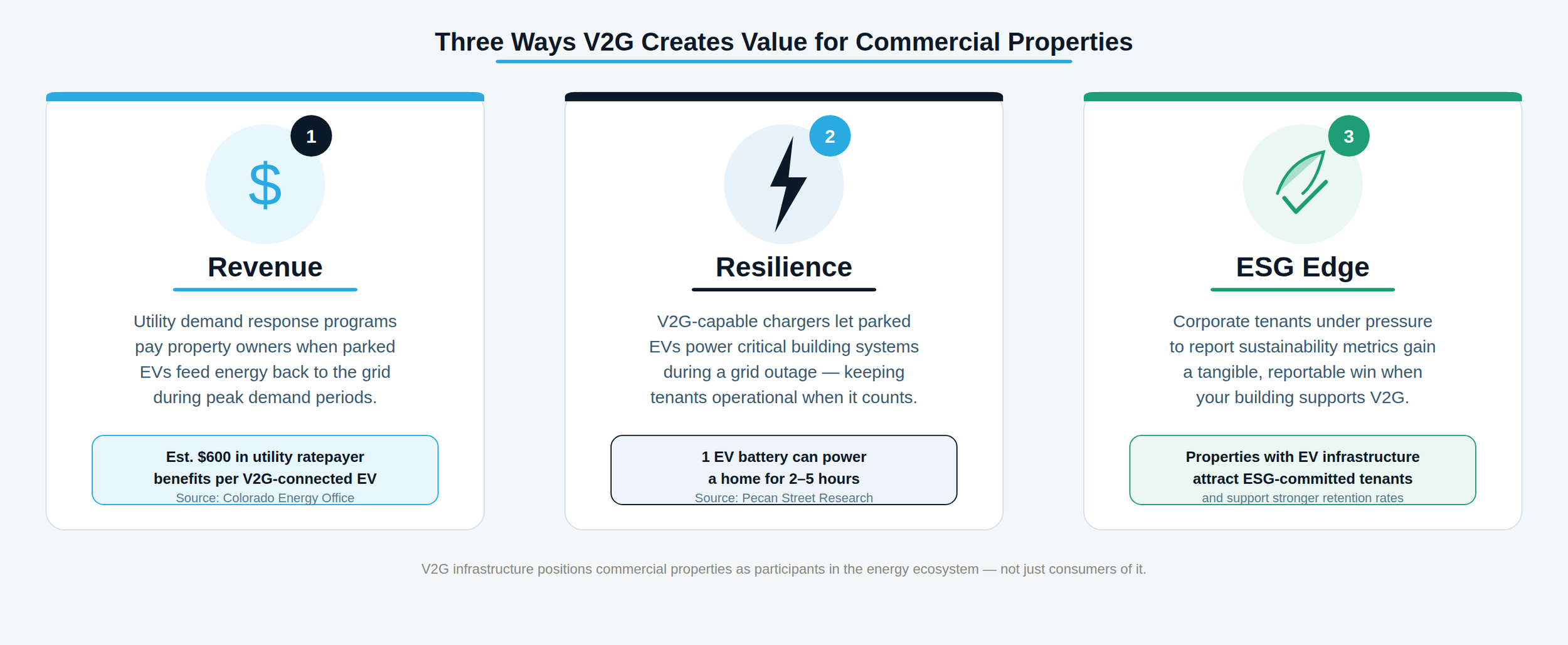
Three Ways V2G Creates Value for Commercial Properties
1. Revenue from grid services
Utilities pay for grid stability. When demand spikes, during a summer heatwave, for example, or on a cold winter evening, utilities need fast-responding energy sources to prevent brownouts. V2G-enabled charging stations allow property owners to participate in demand response programs, earning payments or credits for feeding energy back into the grid at peak moments.
Early studies suggest meaningful financial upside: one analysis by the Colorado Energy Office estimated that each V2G-connected EV could generate around $600 in benefits to utility ratepayers over its lifetime, and as programs scale and bidirectional hardware costs drop, those numbers are expected to improve.
2. On-site resilience and backup power
Grid outages are an increasing concern for commercial tenants, particularly in industries where downtime is costly. V2G charging infrastructure (alongside its close cousin, V2B or vehicle-to-building technology) enables parked EVs to power critical building systems during an outage.
This is more than a nice-to-have. For corporate tenants with business continuity requirements, or for properties in regions prone to weather events or grid instability, backup power capability is becoming a genuine lease differentiator. A property that can keep the lights on when the grid goes down is a different kind of asset.
3. ESG positioning and tenant attraction
Corporate tenants increasingly report to investors, boards, and regulators on their sustainability performance. Scope 3 emissions, which include commuting and business travel, are under growing scrutiny. A commercial property that supports EV charging and participates in grid stabilization programs gives tenants a tangible, reportable sustainability win.
That's not a soft benefit. For tenants trying to meet ESG commitments, your building's infrastructure directly affects their ability to make their numbers. Properties that enable this are simply more attractive, and they command better retention rates and, increasingly, premium rents.
“The conversation is shifting from ‘Do you have EV chargers?’ to ‘What can your charging infrastructure do for our sustainability goals?’ V2G answers that question in a way a standard charger can’t.”
Where V2G Stands Right Now
It's worth being direct about the current state of the technology: V2G is real, but it's still maturing. A few important facts:
Bidirectional charging requires compatible hardware, both the EV and the charger must support two-way energy flow. Not all vehicles or chargers do today, though the number is growing rapidly. GM has announced plans to make V2G standard across its lineup by 2026. Ford's F-150 Lightning already supports bidirectional charging. Nissan, Hyundai, and others are following.
Regulatory frameworks are developing. Maryland became the first U.S. state to pass V2G interconnection legislation in 2024, and other states are following suit. California's updated grid rules already embed EV chargers into the distributed energy resource stack.
The V2G market is scaling fast. Industry analysts project the global V2G market will grow at a compound annual rate of roughly 28% through 2032, driven by rising EV adoption, utility demand for grid flexibility, and falling hardware costs.
The window between "emerging technology" and "standard expectation" is closing. Property owners who install Level 2 charging infrastructure now are positioned to upgrade to V2G-capable systems as the technology and regulation catch up, without starting from zero.
“Installing EV charging today isn’t just about serving current tenant demand. It’s about having the infrastructure in place when V2G becomes the standard, and that timeline is shorter than most people expect.”
What This Means for Your Property Today
V2G doesn't require you to overhaul your infrastructure overnight. But it does require you to think about your charging investment strategically, not just as an amenity, but as a platform.
Here's what that looks like in practice:
Install Level 2 charging now, with V2G-readiness in mind. Choose equipment and electrical infrastructure that can support bidirectional charging upgrades as hardware and regulation evolve.
Ask about utility programs in your area. Oregon and the Pacific Northwest have active demand response programs, and more are coming. Understanding what your utility offers, or will soon offer, gives you a head start on monetizing your charging infrastructure.
Use your EV infrastructure as a leasing tool. Tenants who are actively managing ESG commitments are looking for buildings that help them do it. V2G-capable charging is a story worth telling in your leasing conversations now, even if the full capability is 12 to 24 months away.
The Bottom Line
The cars sitting in your parking lot right now are just cars. Plug them into the right infrastructure, and they become assets, for your tenants, for the grid, and for your property's bottom line.
V2G is the future of commercial EV charging. And the future has a habit of arriving faster than expected.
Want to talk through what EV charging infrastructure, built with V2G in mind, could look like for your property? Reach out and let's start the conversation.