How EV Batteries Actually Work — And Why It Should Matter to Your Property
If you've been hearing more and more about electric vehicles from tenants, investors, or local ordinances, and you're not quite sure what to make of it all — you're not alone. EV adoption is accelerating fast, and commercial property owners are increasingly being asked to get up to speed.
The good news: you don't need to become an engineer to make smart decisions about EV charging infrastructure. But understanding the basics of how EV batteries work will help you ask better questions, evaluate your options, and position your property ahead of the curve.
Let's break it down.
The Battery Is the Engine
In a traditional gas-powered vehicle, the engine converts fuel into motion. In an electric vehicle, the battery does that job — it stores energy and releases it to power an electric motor.
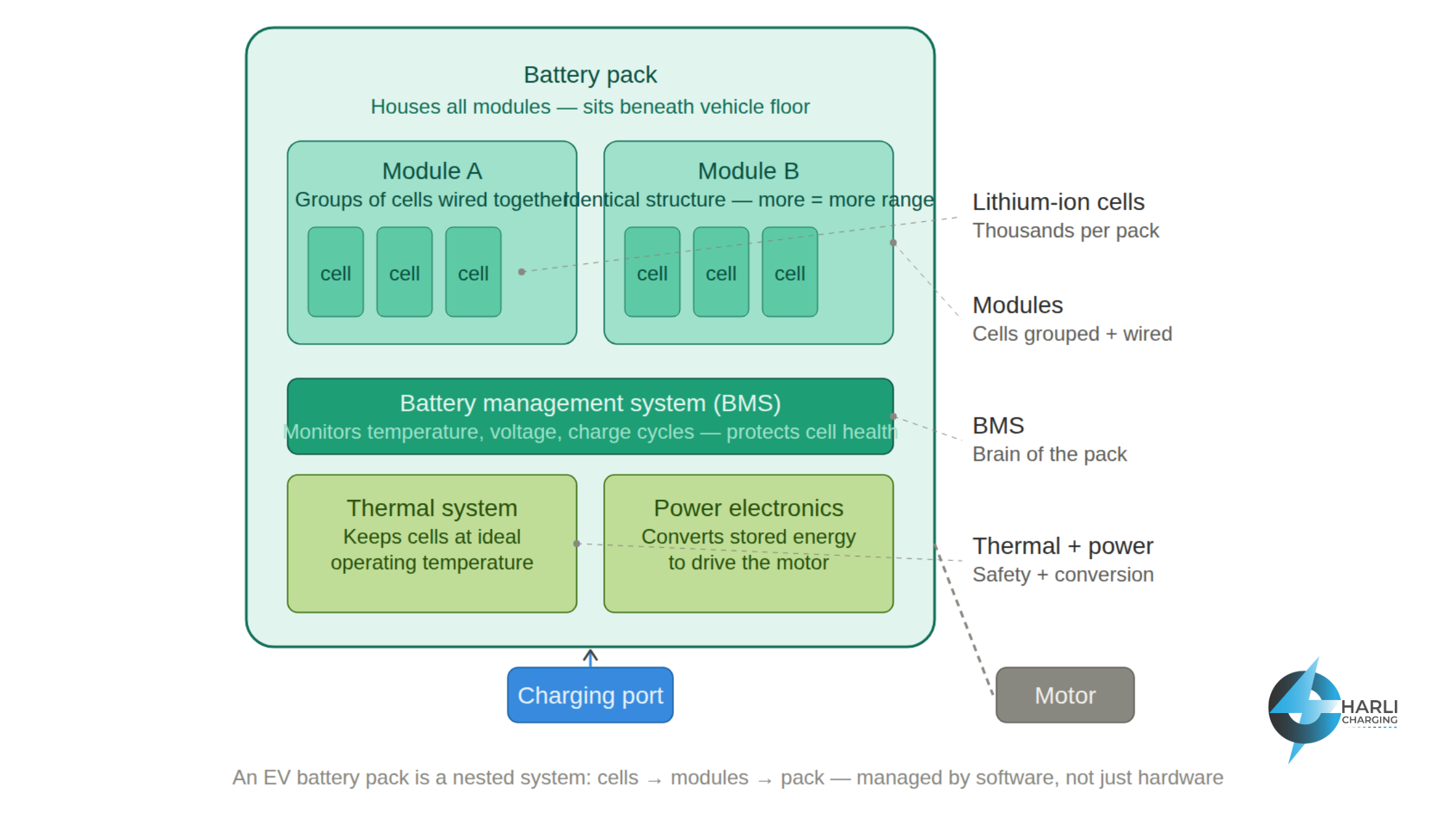
Most EVs on the road today use lithium-ion batteries, the same basic chemistry you'll find in a smartphone or laptop, just scaled up significantly. A typical EV battery pack contains thousands of individual cells grouped into modules, which are then packaged together into a large flat unit that usually sits beneath the vehicle's floor.
Here's what makes lithium-ion well-suited for EVs:
High energy density — they store a lot of power relative to their weight
Rechargeable — they can be charged and discharged hundreds to thousands of times
Improving rapidly — battery technology is advancing quickly, with costs dropping and range increasing year over year
“Think of an EV battery like a very large, very sophisticated rechargeable power bank. The bigger and more advanced the battery, the more range the vehicle has, and the more demanding it is on the charging equipment.”
Charging: Not All Stations Are Created Equal
Here's where it gets practical for property owners. EV batteries don't charge the same way across all equipment. There are three main levels of charging, and each has different implications for what you'd need to install on your property.
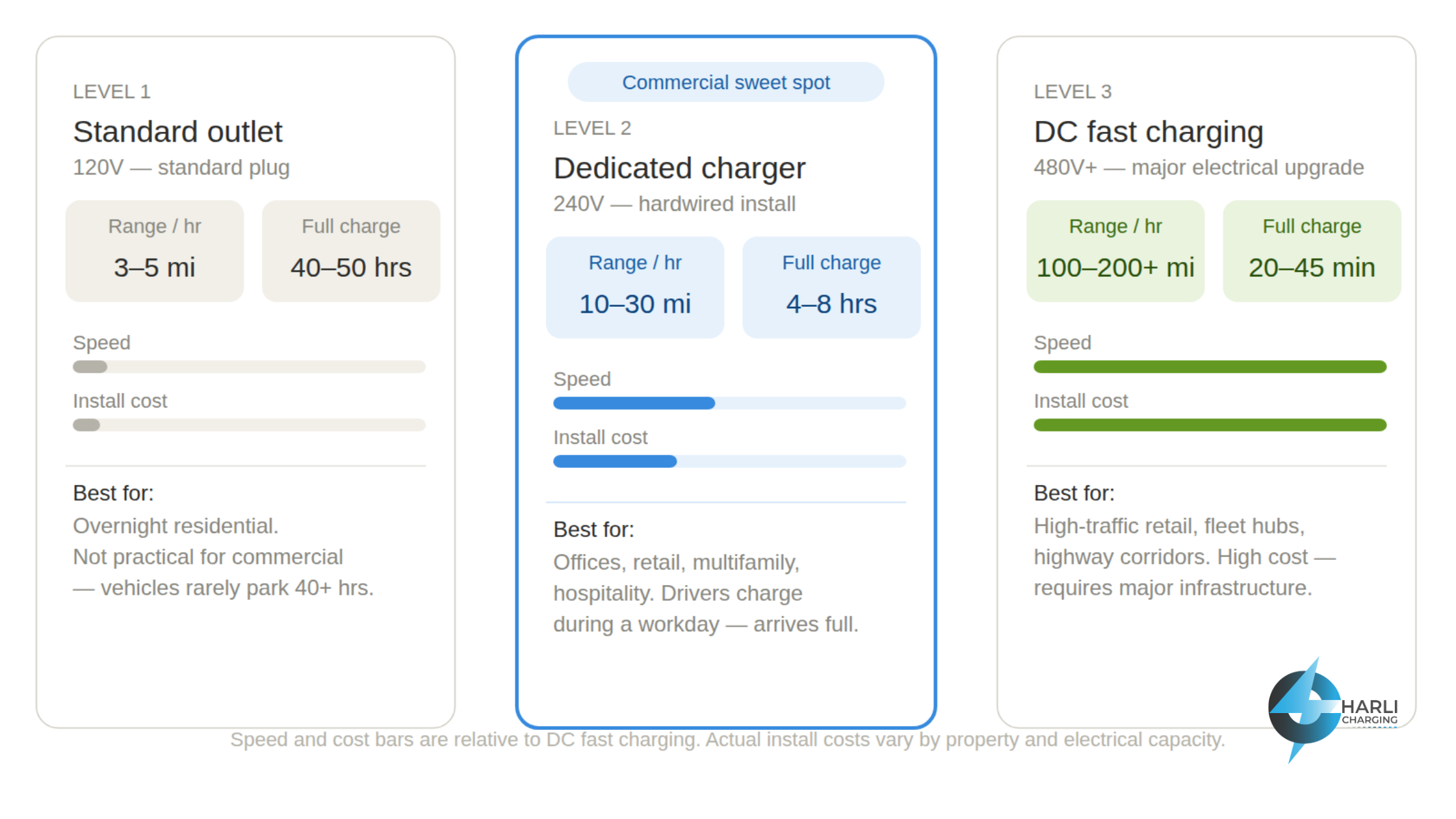
Level 1 — Standard outlet (120V)
This is the slowest option, plugging an EV into a regular household outlet. It typically adds 3–5 miles of range per hour. Useful for overnight charging at home, but not practical for most commercial settings where vehicles aren't parked for 12+ hours.
Level 2 — The commercial sweet spot (240V)
This is the most common choice for commercial properties — office buildings, retail centers, apartment complexes, and hospitality. A Level 2 charger adds 10–30 miles of range per hour, meaning most drivers can fully charge during a normal workday or shopping trip. This is almost certainly what your tenants and visitors are expecting.
DC Fast Charging — High-speed, high-demand (480V+)
DC fast chargers can deliver 100–200+ miles of range in 20–30 minutes. They're common at highway rest stops and dedicated charging hubs. They require significant electrical infrastructure upgrades and carry higher installation costs, but they're increasingly relevant for properties with fleet vehicles, high-traffic retail, or hospitality use cases.
“For most commercial property owners just getting started, Level 2 charging strikes the right balance, affordable to install, genuinely useful to EV drivers, and increasingly expected by tenants.”
What About Battery Range and Degradation?
One of the most common concerns we hear from property managers: "Will the batteries just wear out?" It's a fair question.
EV batteries do degrade over time, similar to how a phone battery holds less charge after several years. But modern EV batteries are designed to retain around 70–80% of their original capacity after 8–10 years of typical use. For most drivers, that's still plenty of range for daily needs.
Battery management systems in modern EVs actively monitor temperature, charge cycles, and cell health to maximize lifespan. Many automakers now back their batteries with 8-year, 100,000-mile warranties, which tells you something about how confident they are in the technology.
For property owners, the key takeaway is this: EV drivers aren't worrying about running out of battery permanently. They're thinking about where they can conveniently top off their charge during the day. That's where your property comes in.
Why This Matters for Your Commercial Property
Understanding EV batteries isn't just a technical curiosity, it has real implications for how you think about your property's future.
Tenant expectations are shifting. Corporate tenants with ESG commitments are increasingly looking for buildings that support sustainable transportation for their employees.
EV adoption is accelerating. More than 1 in 10 new cars sold in the U.S. in 2024 were electric. That number is growing, which means more of your tenants and visitors will need a place to charge.
Infrastructure takes time. Electrical upgrades and charger installation don't happen overnight. Properties that plan ahead will be better positioned than those playing catch-up.
Charging is becoming a competitive amenity. Like WiFi or covered parking, EV charging is moving from "nice to have" to "expected."
“The properties that win long-term aren’t just the ones with the most amenities, they’re the ones that anticipated what tenants would need before they had to ask.”
Ready to Talk About What's Right for Your Property?
Every property is different, the right charging solution depends on your building's electrical capacity, your tenant mix, your parking layout, and your goals. That's exactly what we help commercial property owners figure out.
Whether you're just starting to explore EV charging or ready to move forward with installation, we'd love to have that conversation.
Get in touch today to learn how we can help you take the next step.