Why More Commercial Properties Are Installing EV Chargers
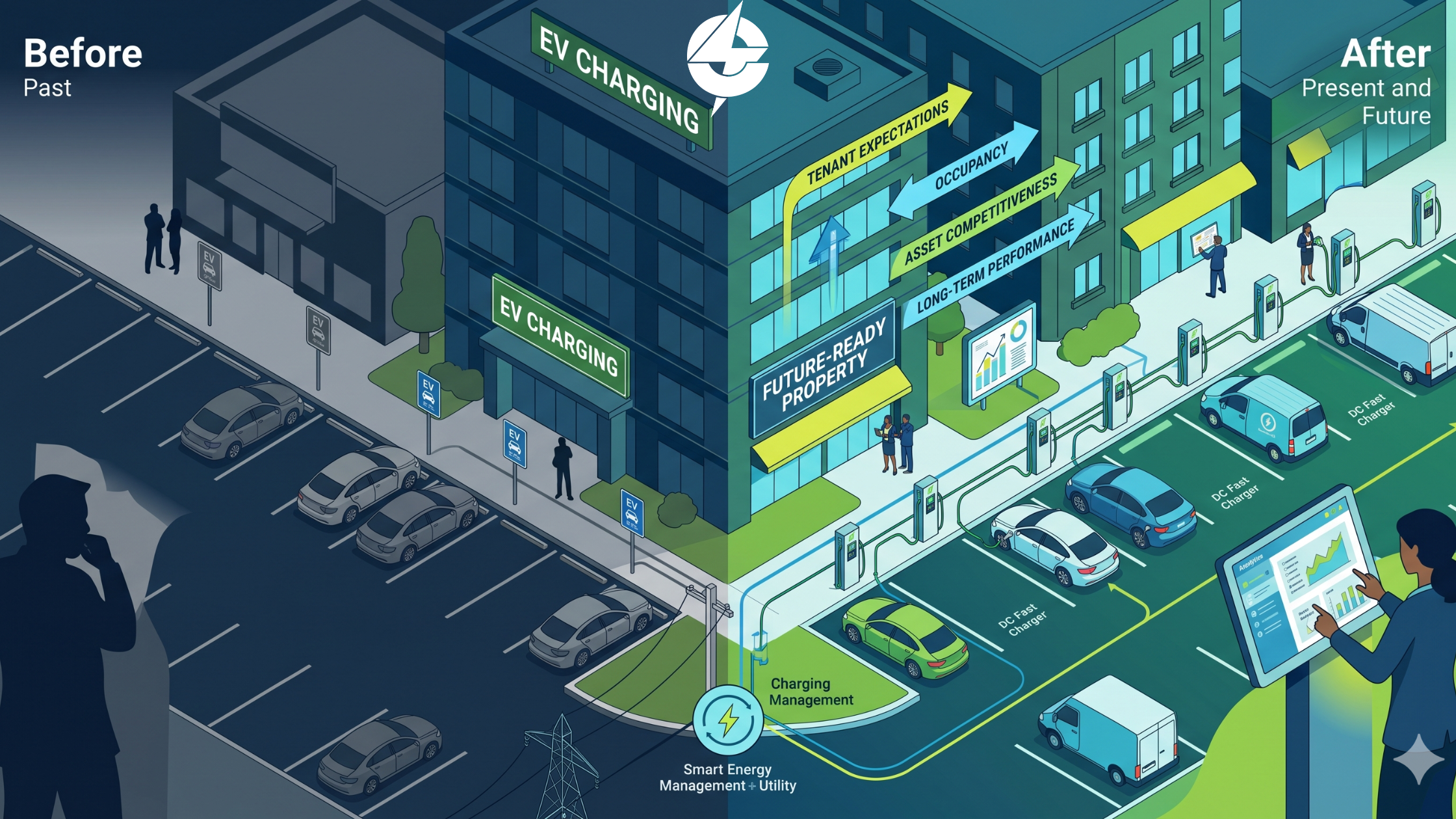
A few years ago, many commercial property owners viewed EV charging as a future consideration rather than an immediate business priority. Electric vehicle adoption was growing, but for many owners, transportation remained separate from property strategy. Employees figured out how to get to work, residents handled their own charging needs, and customers arrived however they chose. Property owners focused on leasing space, maintaining operations, and managing assets.
Today, those conversations look very different.
When we speak with property owners, developers, and asset managers, the discussion rarely begins with electric vehicles themselves. Instead, it often starts with questions about tenant expectations, occupancy, property competitiveness, and long-term asset performance. Owners want to understand how people are using their properties, what tenants are asking for, and which investments will help their assets remain relevant over the next decade. As those conversations evolve, EV charging increasingly becomes part of the discussion because transportation is becoming more closely connected to the overall property experience.
Transportation Has Become Part of Property Strategy
Commercial properties no longer operate in isolation from broader transportation trends. The way people travel to a property influences how they experience it, whether they are employees arriving at an office, residents returning home, or customers visiting a retail location.
That shift is causing many property owners to rethink the role their properties play in supporting transportation needs. Parking, charging, accessibility, and convenience are no longer viewed solely as operational considerations. They are becoming factors that influence tenant satisfaction, leasing decisions, and long-term asset value.
Property owners are recognizing that what happens outside the building can have a meaningful impact on what happens inside it. A tenant evaluating office space may consider whether employees have access to charging. A multifamily resident may compare properties based on available amenities. A retailer may look for ways to encourage customers to stay longer and visit more frequently. Transportation infrastructure increasingly supports all of those objectives.
Tenants Are Evaluating Properties Differently
Tenant expectations have changed significantly over the past several years.
Office tenants are focused on attracting and retaining employees in an increasingly competitive labor market. Multifamily residents expect amenities that reflect modern lifestyles and technology adoption. Retail tenants want properties that support customer convenience and create a positive visitor experience.
As a result, commercial tenants are asking more detailed questions about infrastructure. They want to understand whether a property can support future growth, adapt to changing transportation trends, and provide amenities that matter to employees, residents, and customers.
EV charging is often part of those conversations because tenants recognize that vehicle ownership patterns are changing. They are not necessarily looking for a property with dozens of chargers installed on day one. They are looking for evidence that ownership understands where the market is heading and has a plan to accommodate future demand.
That distinction matters because property competitiveness is rarely determined by a single amenity. Instead, tenants evaluate the overall quality of an asset and its ability to support their long-term needs. Charging infrastructure can contribute to that perception by demonstrating that a property is investing in future readiness rather than simply reacting to current demand.
Parking Areas Are Serving a Larger Purpose
Many commercial properties already have one of the most valuable assets needed to support EV charging: parking.
Historically, parking areas existed primarily to provide access to a building. Today, property owners are increasingly viewing those same spaces as opportunities to enhance tenant experiences, support transportation needs, and strengthen overall property performance.
This shift reflects a broader change in how owners think about infrastructure investments. Rather than viewing parking solely as an operating necessity, many are evaluating how those spaces can create additional value. EV charging represents one example of how existing infrastructure can support evolving tenant expectations without fundamentally changing the property's core function.
The conversation is becoming less about adding chargers and more about making strategic use of assets that already exist.
Energy Infrastructure Is Becoming a Business Consideration
EV charging also introduces a broader discussion about energy infrastructure.
Property owners evaluating charging projects often find themselves reviewing electrical capacity, utility coordination, future expansion opportunities, and long-term energy requirements. While those conversations may initially be driven by a charging project, they frequently provide valuable insight into the overall readiness of a property.
Understanding electrical infrastructure helps owners make more informed decisions about future investments. It can reveal opportunities for phased expansion, identify potential constraints before they become costly problems, and support long-term planning efforts.
Many owners find value in these assessments regardless of how many chargers they ultimately install because the information helps them better understand how their properties will support future technology and tenant needs.
Looking Beyond Current Demand
One of the most common questions property owners ask is whether current EV adoption justifies installing charging infrastructure today.
While utilization rates are certainly important, commercial real estate decisions have always required a longer-term perspective. Owners routinely make investments based on future demand, projected market conditions, and long-term asset performance rather than solely on present-day usage patterns.
The same approach applies to EV charging.
Property owners understand that buildings often remain in service for decades. During that time, tenant expectations, transportation technologies, and infrastructure requirements will continue to evolve. Decisions made today influence how well a property can adapt to those changes in the future.
Many owners are installing EV chargers because they view the investment as part of a broader strategy to maintain competitiveness, support tenants, and position their properties for long-term success.
The Bigger Picture
The growing interest in EV charging reflects a larger shift taking place across commercial real estate. Property owners are increasingly evaluating transportation, parking, energy infrastructure, and tenant experience as interconnected parts of property strategy rather than separate issues.
That perspective is changing how owners think about investments, amenities, and long-term planning. Charging infrastructure sits at the intersection of several important trends, including evolving transportation habits, changing tenant expectations, and growing demand for modernized property amenities.
For many commercial property owners, the question is no longer whether transportation affects property performance. The question is how to respond to those changes in a way that supports tenants, strengthens asset competitiveness, and creates long-term value. As a result, EV charging has moved from a future consideration to an increasingly common component of modern property strategy.